top of page
Search
  • Writer: Amber Osterhout
    Amber Osterhout
  • Mar 3, 2021
  • 3 min read

When you're raised by a mother who makes upholstery work seem more like a journey and less like a challenge, it's hard not to fall in love with this craft.

I'll never forget when I set eyes on these French style cane back chairs while cruising Home Goods. We'd just moved into our new home in 2017 and I hadn't found the right counter stools for our kitchen. This, after all, was a new concept since our last house only had room for a family size table and chairs when it came to meals. The vision of me serving our children meal after meal as they sit at our new kitchen island made my heart happy :) As you can see from the photo below, it wasn't long before each chair was riddled with stains. Now I know kids will be kids, but much of the staining seemed to occur when water reacted with (what appeared to be) a stain protector. As soon as the stain was gone, a large water mark remained. Yes, I fought the fabric but the fabric won.


THE BEFORE & AFTER

Fabric Selection

Obviously, the only way to eliminate a web of blotchy stains is to reupholster each stool. The question remained...which fabric would make the cut (no pun)? Chenille and velvet are very forgiving because the nap is consistent and bounces back easily. Perfect for regular spot cleanings. When it came to color choice, the darker the better. Subtle stains will go unnoticed while food particles will brush away with ease.

Tools of the Trade

As involved as upholstery work can be, there's really only a select number of tools needed. Well that, and a ton of patience. Below are the tools I used in this project. The cordless Arrow staple gun is a necessity! This brilliant tool makes fabric application a breeze and prevents your hand from cramping. I usually go with 3/8" staples. Long enough to hold and short enough to remove (if needed). A small set of fabric scissors and new razor blade will allow you to get up close and personal when cutting fabric away. This was my first time using a nailhead trim. I was a bit skeptical but soon grew to love this product! If you only knew how many hours of my life have been lost hammering individual tacks into wood.


Cordless Staple Gun / Fabric Scissor / Razor / Staples / Nail Trim


Prepping for Fabric

I always study each reupholstery project to determine what needs to be removed. More importantly, in what order. It's always smart to take photos if the project involves many layers/steps. In this case I removed the existing fabric trim with a strong set of pliers, as well as any remaining staples. Pretty straight forward.

Affixing the Fabric

After sizing the fabric I placed a few staples at the middle of all 4 sides. This helps secure the fabric as I move towards the corners. The goal is a smooth, somewhat tight fit with no buckles, creases or loose ends. It should fit like a drum.

Corner Detail Work

As I moved towards the dreaded corners, I spent most of my time mapping out how the fabric would wrap around each corner before stapling everything down. The area around both back corners required the most attention to detail. I had to cut at an angle to give myself enough slack to tuck and secure the remaining fabric.

Cutting it Close

Since I knew the nail trim would cover my line of staples, I had to cut as close as possible to that line so that no fabric was peeking from under the trim. This required a very sharp razor and/or small set of fabric scissors. I repeat, the sharper the better. Be extra careful during this step!

Step Five

And now for my favorite part. Adding trim! Not only does the trim cover up staples and the frayed fabric edge, it also marks the end of the project. If you are new to upholstery work, I highly recommend this trim. It's very forgiving.

And there you have it! From stain riddled to riddled with beauty. After a little attention to detail and DIY magic, these vintage inspired chairs now have a new lease on life. And to my kids...I know messes can and WILL happen, but these chairs are ready for ya. Come on down and take a seat.


  • Writer: Amber Osterhout
    Amber Osterhout
  • Feb 14, 2021
  • 4 min read

Updated: Feb 15, 2021

Utilitarian spaces always seem to evolve as the needs of a family change. Aside from the kitchen, our mudroom takes quite a beating throughout the day. And after three years I thought it was time for a little facelift to join form and function.


THE BEFORE & AFTER

While there wasn't anything I hated about the before shot, something felt "off" to me. And since I pass through this space numerous times each day, it dawned on me. It was the door! I'm the type of designer who won't sit still until a space feels "complete". Sure, the door serves its purpose as a fire rated entrance to the garage, but could it look less...well, utilitarian?

With an open floorpan, our mudroom sits right off the dining room. For this reason it was important to bring in design elements from the rest of the home. Wicker for texture, storage and to soften the space. A $30 vintage knockoff rug (below) that I've had for about 7 years. I'm surprised by how well it holds up in here with all the boot traffic. A sturdy wood bench for when you need to remove said boots. The wall basket below holds our keys (both functional and attractive). The bronze, vintage fox hook once lived in Parker's bedroom at our old house. I just hadn't found another use for it...until now. I love how it adds character and serves as a reminder of what lives beyond our garage doors. Life at the gateway to the Adirondacks comes with its fair share of wildlife.

Who says you can't turn metal into wood?

And now for the catalyst that inspired this mudroom makeover. I'll be honest, I had very few exceptions when planning this door transformation. Not to mention, there are next to zero tutorials online. All I had to go on was a dream and my usual stubborn ambition to make that dream come true...or fail miserably (I was banking on the latter).

Just wing it, right? That's my motto when I have an idea I just can't shake. I spent a few nights researching wood veneers before pulling the trigger on the right one. Poplar being my baseline since it's used in our beams and for door trim. This meant I needed to find a wood species that would take stain in the same manner and have a consistent grain pattern. I kept coming back to birch. Poplar and birch not only have similar grain patterns, but also lack red and yellow undertones that come with other wood species. Those undertones would be amplified once stain is applied. This would lead to clashing between woods and that's a big NO NO!

After the research phase was complete I decided on a WiseWood birch veneer in the 2x8' size. I made sure to select the option with 3M™ pressure sensitive adhesive backing for easy installation. As their website states,"When it comes to high quality, flexible wood veneer sheets, you have many great options. Our veneers come in a wide variety of species and sizes, ideal for any budget or application. Choose from a number of backers, including paperbacked FlexVen™ 10 Mil & FlexVen™ 20 Mil, polyback Tuf-Pli™, and 2-ply wood Pli-Flex™."

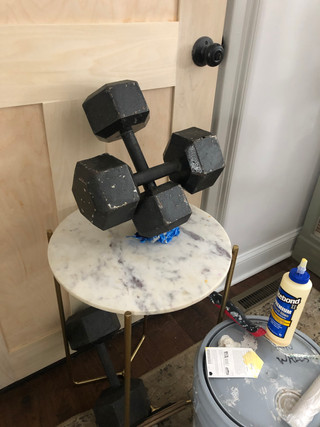
If I was going to question whether or not this transformation would even work, it was at this stage. Luckily, it took all of 10 minutes to line up and affix the veneer to the door (phew). The only draw back being that the metal door has valleys for air pockets to exist once the veneer was set. I tried not to dwell on it and allow my OCD to present a list of "what if's" in my head, so I moved on. What allowed me to move forward was knowing that the trim pieces would further secure the veneer on either side of the door, preventing any curling over time. Most veneers sheets come in 2 foot wide sections. This left just enough surface area for the trim to lock down the veneer's edge while covering the remaining exposed metal. Adding the horizontal trim pieces was straightforward, with a few hiccups. With the poplar trim being just 1/4" thick, I did notice some slight warping on a few corners when adhesive dried. Not to worry! My husband's 50 lb weights helped those stubborn corners stay put.

After the door was stained my nerves were calm again. You could barely tell that the veneer and trim are different wood species. But that nagging feeling still remained. Something felt incomplete. With such a strong focal point, it made sense to balance the stained wood by updating the door molding. I installed a 6" tall piece of trim on top of the existing molding along with a modest crown. A reminder of how much I dislike calculating miter joints.

The only regret I have is how we could have saved money by constructing built-ins by hand. While functional, the piece below does not utilize the ceiling height. We may add plan to build more storage above at some point. Live and learn ;)

If given the chance I'd do it all over again!


  • Writer: Amber Osterhout
    Amber Osterhout
  • Jan 14, 2021
  • 4 min read

Updated: Feb 14, 2021

In order for an office to be successful, many feel that function should overshadow form...or should it?

When it was time to refresh my office space, I wanted there to be a balance between how it looked and how it functioned. From the moment I wakeup in the morning, there is a toddler glued to my leg and client emails flowing in. This space needed to reflect my needs. I also wanted to be smart about my design choices by keeping cost low. Mama loves to save $$$

My style tends to blend old with the new. I've been collecting vintage pieces for about 20 years, scouring antique sales and facebook marketplace for that perfect find. I also have a great appreciation for more contemporary lines, with a nod to mid-century modern styles. You'll notice in the photo below how I achieve this balance by incorporating softer textures (blinds, storage baskets and linen curtains) with high contrasting storage structures (shelving unit, base cabinet, curtain rod and wire shelves as desk supports). Balance is key!

One way I saved money was up-cycling a few pieces I already owned. Like this vintage chair (circa 1960's) I inherited from my grandmother, wire shelves for desk supports and refinishing a slab of maple I had made around 10 years ago. The chair and desk took the most time to transform. With its many contours and crevices, taking the chair down to it's original wood grain required lots of patience and elbow grease. The storage baskets are a perfect example of how form meets function. The wicker's hue & texture relate to similar pieces in the room while storing loads of colorful toys...but you wouldn't know it because they're hidden. I also love how the baskets are within arms reach of a certain toddler. Hello function!

The following tools were used to remove all stain from the desk (previously covered with a grey stain). It took many passes with my electric sander before I uncovered the original wood grain. I proceeded to stain the surface with the same Minwax Driftwwood I used on the ceiling beams. However, I anticipated the stain to look different between wood species, so I developed a backup plan. As expected, I noted a much warmer result on maple wood grain than I did on the poplar. SOLUTION: tone down warm hue with some pickling stain. I diluted with mineral spirits because it's much easier to "add" more coats than it is to remove.

As you can see below, the hours spent refinishing/up-cycling two key pieces resulted in a harmonious focal point for the space. I love how a little blood, sweat and tears can transform something you've owned for years. So worth it!

Form and function are on display when it comes to new shelf set up. Sadly, I had to kiss my dreams of buying a new pair of shelving units or bugging Michael with yet another custom built-in project...goodbye. But I love a challenge! Especially one that forces me to get creative in order to save money. More on that later. When styling office shelves, I have a 2/3 rule. Two thirds of the shelves should store and organize, while the other 1/3 displays items with interest and personality.

The following are a few book finds I love to reference when switching up interior design. Styling with books is a great way to put your personality and interests on display.


Let me Take a Shelfie

As I mentioned before, I did not want to buy new shelving units that would break the bank. Nor did I want to burden Michael with yet another DIY builtin project. So I came up with a solution to keep cost down by using the same metal shelves I found at Target 2-3 years ago. I decided to hoist the metal units up in order to fill in negative space (we have a 9 foot ceiling height). They now sit on top of new base cabinets (source below) appearing as though they are part of a single shelf unit. Same color, more storage. WIN WIN!

While selecting items for a space, form and function are always in the forefront of my mind. And since the goal was to keep cost down, I was only able to splurge on a few items.


On the opposite side of the room "sits" a futon couch we've owned for years. This futon functions as a sitting area and spare bed when relatives come to visit. It also serves as a place for me to develop creative ideas and/or drink tea while I play with Adia. Last year I created a gallery system made from art in cohesive white frames. Aside from my expansive fabric collection, I am constantly adding to my stash of artwork. It's a mild addiction, ha. An office space should reflect your personality while inspiring you to create your best work.

I'm always looking for ways to bring the outdoors in. Since we live in the country, it only seems fitting. I love how these dried babies breath work with the natural wicker. Vintage inspired pottery from HomeGoods.

Follow on Instagram >>


Join My Mailing List

Thanks for submitting!

  • Grey Instagram Icon
  • Grey Pinterest Icon
INSTAGRAM@OBSESSIVISION

© 2021 by Obsessivision​. Proudly created with Wix.com

bottom of page